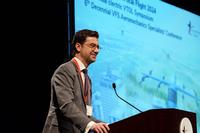
Carl Russell
Born: United States of America
Primarily active in: United States of America
From Leadership Profile
Vertiflite March/April 2026
Engineering Phenom Embraces Vertical Lift Leadership
Carl Russell’s path to leading NASA Ames’ Aeromechanics Office did not begin in a laboratory or wind tunnel. It began in northern New England, shaped by seasons, science and a quiet aptitude for solving problems.
Born in New Hampshire and raised in northern Maine, Russell grew up in an outdoors-oriented family. His father, a fisheries biologist with the US Fish and Wildlife Service, and his mother, an educator who later taught environmental science through the Maine Audubon Society, fostered a deep appreciation for the natural world. Hiking in the White Mountains and along the Appalachian Trail was commonplace. The environment was less about aviation, and more about curiosity.
In school, Russell was naturally gifted in mathematics and physics. “Anything that was problem-solving related as opposed to memorization related,” he recalls, “just kind of made sense to me.” Calculus felt intuitive; physics was engaging. Chemistry and biology, with their emphasis on memorization, were less compelling.
At the same time, airplanes captured his imagination. “I was really interested in airplanes… I just thought they were really cool.” Strong in math and drawn to flight, aerospace engineering felt like an obvious direction. “I never really even considered doing anything else.”
Boston University and Early Research
Russell chose Boston University (BU) for his undergraduate degree in aerospace engineering. While BU’s program leaned heavily into mechanical engineering disciplines, particularly vibrations, acoustics, and biomedical applications, the academic rigor was strong.
As a freshman, he joined BU’s Freshman Research Opportunity Program, working on control systems for a flying-wing laboratory experiment. It was his first exposure to research. Later, he joined the university’s rocket team and participated in high-power rocket launches and motor testing. He also interned at GE Aviation in Lynn, Massachusetts, working on combustor design for the CT7 helicopter engine, the commercial variant of the T700 used in the UH-60 Black Hawk.
He also completed an internship with Acentech, supporting an Army Small Business Technology Transfer (STTR) project investigating whether vibration sensors mounted on building exteriors could identify internal machinery. His role involved ground vibration testing, a skill that would unexpectedly reappear throughout his career.
“Ground vibration testing ended up being a pretty big part of my career,” he notes with a smile.
Stanford and a Turning Point
After graduating from BU, Russell pursued a master’s degree in aeronautics and astronautics at Stanford University on fellowship. Initially considering a Ph.D. and a potential academic career, he completed Stanford’s intensive course-based master’s program in nine months.
It was during graduate school that he realized his interests were broader than a narrowly defined research path. “I just was not… focused enough on a particular topic to say, ‘Yeah, I want to keep doing a Ph.D.’” Instead, he turned his attention toward applied engineering, and NASA.
Early NASA Career: Airspace Systems
Russell joined NASA’s Ames Research Center in California’s Silicon Valley in 2007 through the Federal Career Intern Program (a predecessor of the current Pathways program). His first role was in the Aviation Systems Division, focused not on aircraft hardware but on modeling the National Airspace System (NAS).
Using large-scale simulation tools capable of modeling tens of thousands of daily flights, he studied system-wide efficiency metrics such as cumulative delay. One early project examined whether traffic could be offloaded from major hubs to nearby regional airports to mitigate congestion growth.
At the time, air travel was projected to expand significantly. “If you want to start pumping through 100,000 flights a day instead of 50,000,” he explains, “what does that do to delay?”
The work was technically rich, but it wasn’t aircraft-centered. Russell found himself wanting to return to hardware and vehicle design.
Returning to Rotorcraft
In 2011, he transferred to NASA Ames’ Aeromechanics Office under rotorcraft legend Dr. William (Bill) Warmbrodt. There, Russell began working with Dr. Wayne Johnson on conceptual design studies under NASA’s Subsonic Rotary Wing project. Using NASA’s Design and Analysis of Rotorcraft tool, he explored what a 90-passenger compound helicopter might look like, and whether it could compete with NASA’s Large Civil Tiltrotor (LCTR) concept. “It was a really good entry into rotorcraft,” he says, “working with the guy who literally wrote the book.”
He also led major ground vibration testing efforts for NASA’s Tilt Rotor Test Rig and later participated in wind tunnel campaigns in the 7- by 10-foot wind tunnel at Ames, managed by the US Army, including joint NASA-Army testing of large-scale tiltrotor configurations.
Through these programs, Russell developed deep expertise in rotorcraft performance, testing, and conceptual design, bridging theory and experiment.
From Engineer to Leader
In 2020, Russell moved into project leadership as an associate project manager for NASA’s Revolutionary Vertical Lift Technology (RVLT) project. There, he gained experience in programmatic management, balancing budgets, strategy, and technical direction.
When Bill Warmbrodt announced his retirement in 2024, Russell stepped forward as a candidate to lead the Aeromechanics Office. After interviews with Ames leadership, he was selected as office chief.
“There’s definitely a lot that goes into being an office chief,” he reflects. “I’m still learning what I don’t know… I’ve got to get good at this job first.”
His focus now lies in cultivating technical excellence, mentoring younger engineers, and ensuring rotorcraft research remains relevant in NASA’s broader aeronautics strategy.
A Commitment to the Community
Russell has also been deeply engaged with the Vertical Flight Society since 2011. He served as president of the San Francisco Bay Area Chapter, chaired technical sessions, rotated through leadership roles in the Dynamics and Advanced Vertical Flight Technical Committees, and later joined the VFS Technical Council. His involvement reflects a broader philosophy: leadership is built through service.
Looking Forward
Nearly two decades into his NASA career, Russell remains energized by vertical flight’s open research questions. While
he avoids speculation about future roles beyond his current office chief position, he notes that NASA has come to feel like Northern New England. The Bay Area may lack the four distinct seasons he grew up with, but it’s home.
A colleague once told him, “If you make it 10 years at NASA, you’re probably a lifer.” Now approaching 20 years, Russell smiles at the thought. From a childhood spent exploring New England forests to leading rotorcraft research at one of the world’s premier aeronautics institutions, his journey has been guided less by grand plans than by steady curiosity, technical rigor, and a willingness to step into new challenges.
And as vertical flight enters its next chapter, that combination may prove more important than ever.